




The One Place on Long Island Where the Deck Is the House
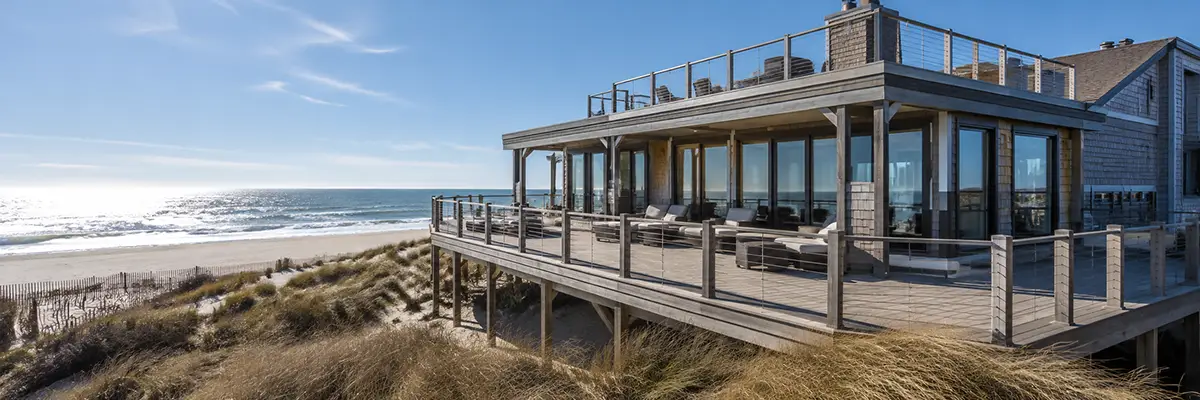
Everywhere else we build, a deck is an addition. On Fire Island, the relationship is reversed. Houses sit on pilings over sand, connected to each other and to the ferry dock by boardwalk. The walkway to your front door is decking. The "street" outside is decking. Living space wraps the house in decking, and on many homes the best room is a rooftop deck looking over the dunes to the open Atlantic. When a community is built almost entirely of deck boards, who builds those boards matters more here than anywhere else.
Long Island Deck Company, a Decks Unique company, has spent 39 years building decks across Nassau and Suffolk, and the beach communities use all of that experience at once: marine-grade engineering, honest guidance for full salt exposure, and the logistics of building on an island with no cars.
How a Deck Gets Built When You Can't Drive a Truck to It
This is the question every Fire Island homeowner asks first, and it deserves a real answer.
Everything arrives by water
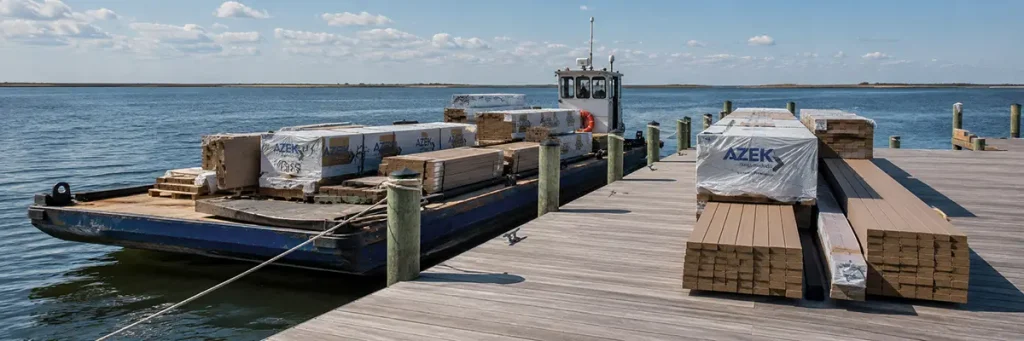
There is no pulling a lumber delivery up to the curb in Saltaire or the Pines. Material for an island build is staged on the mainland, organized into complete, pre-measured packages, and moved across the Great South Bay by freight boat or barge - out of Bay Shore for the western communities, out of Sayville for Cherry Grove and Fire Island Pines. Every freight run is scheduled, weather-dependent, and paid for, so a builder who shows up short one beam can lose days, not hours. We plan island material lists the way a boat is provisioned - counted twice, cut lists confirmed, hardware boxed by phase - because the lumberyard is on the other side of the bay.
The last hundred feet move by wagon
Once material lands at the dock, it travels the way everything travels on Fire Island - by hand cart and wagon down the boardwalks to your property. That shapes board lengths, framing packages, and demolition debris, which leaves the same way new material arrived. Crews work around ferry timetables, with tools planned so the team is self-sufficient for the day. None of this is exotic to us; it is the discipline the island demands, and it is why most deck companies quote Fire Island work reluctantly or not at all.
A Short Season, Planned Backwards
The island runs on a compressed calendar. Homeowners want decks ready for Memorial Day, renters arrive in June, and many communities limit construction during the height of summer. So we plan Fire Island projects backwards from the season: design and material selection in fall, permits over the winter, construction in the spring or fall windows when crews and barges can work freely. Call us in April hoping for a July deck and we will be straight with you about what is realistic. Call us in September and you are planning it exactly right.
Decking That Survives the Open Atlantic
Direct ocean exposure is the toughest test a deck material can face: salt air, blowing sand, hard UV off the water, and storm-driven wind and spray. This is where our material guidance gets blunt.
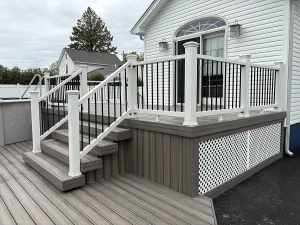
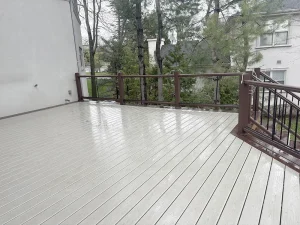
For the walking surfaces, most of our island clients land on PVC decking or a capped composite from the top Trex and TimberTech lines. PVC contains no wood fiber at all, so there is nothing in the board for moisture and salt to attack - a real advantage on oceanfront and rooftop applications. As Trex Platinum and TimberTech Pro certified builders, we back eligible Trex Signature and Transcend decks with a 10-year labor warranty on top of fade-and-stain coverage that runs up to 50 years on the premium lines. For homeowners who want real wood - and on Fire Island plenty do, because weathered-silver boardwalk lumber is the island's signature look - we explain honestly what the ocean will do to it and how to choose species and fasteners so the graying is character, not decay.
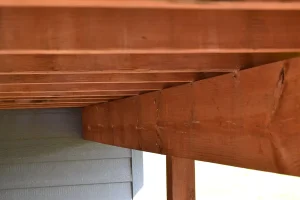
Underneath, every board is only as good as its frame. We build with kiln-dried-after-treatment (KDAT) framing, which starts drier and stays straighter than standard treated lumber and carries a limited lifetime transferable warranty, paired with stainless and marine-grade connectors, joist tape over every framing member, and hurricane-rated hold-downs. On a barrier island that takes the first hit from every nor'easter, the continuous load path from footing to railing is not a code formality. It is the whole game.
Walkways, Wraparounds, and Rooftop Decks
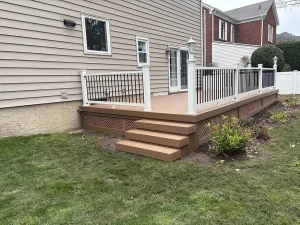
Fire Island projects rarely look like mainland projects. A single property might involve the entry walkway from the boardwalk, a wraparound main deck, an outdoor shower enclosure, and a rooftop deck with railing engineered for ocean wind. Rooftop work especially rewards experience - structure, waterproofing, wind loads, and railing design have to be resolved together - so we design it all as one connected system, one piece of architecture rather than a collection of platforms. Our full range of services - composite and wood construction, railings, lighting, and outdoor structures - applies on the island just as it does on the mainland; the engineering just works harder.
Pergolas Built for Ocean Wind
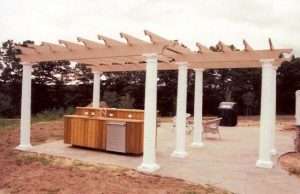
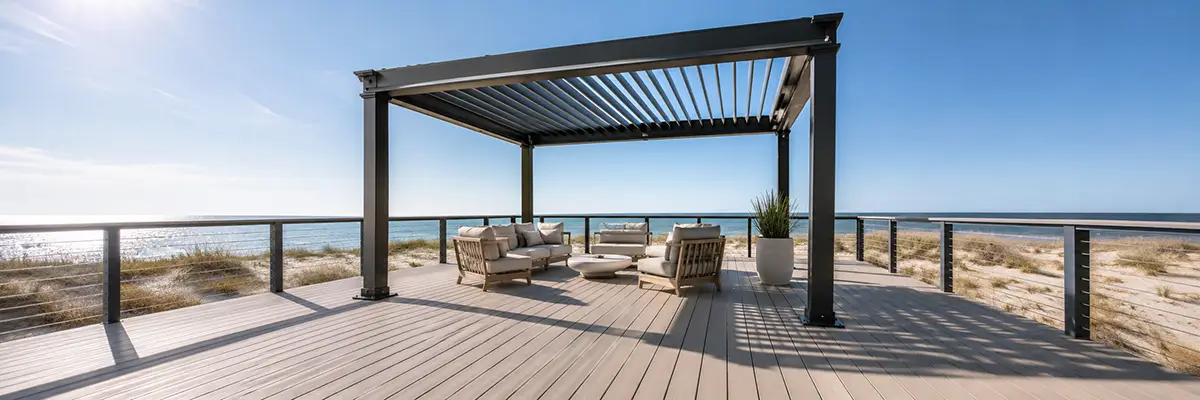
Shade matters on a barrier island with almost no tree cover, but a pergola at the beach has to be anchored differently than one in a sheltered backyard. We build traditional fixed pergolas and automated louvered pergolas whose roof blades open to the sky, close against rain, and can be set to spill the wind. On exposed oceanside decks the conversation starts with anchoring and wind rating before it gets to style - and because louvered systems adjust to conditions, they have become one of our most requested island features, turning the brightest hours of the day back into usable space.
Resurfacing: New Life on Sound Framing
A lot of Fire Island decking is original to houses built decades ago, on framing that is still structurally honest. When inspection confirms the bones are good, deck resurfacing - new decking and railings over the existing structure - is often the smartest project on the island, because it sharply cuts the material that has to barge in and out. We evaluate the framing first, reinforce where needed, upgrade flashing and hardware while everything is open, and give you a straight answer if the structure has reached the point where resurfacing would just be burying a problem.
The Communities We Serve, Bay to Ocean
Each community has its own personality and its own expectations for how work gets done.
- Kismet - the westernmost community, closest to the bridge and the lighthouse, with a casual fishing-village character.
- Saltaire - an incorporated village with deep pride in its boardwalk streets; projects here are planned around the village's calendar and standards.
- Fair Harbor - a family community where the walk from bay to ocean takes minutes and summer days begin and end on the deck.
- Ocean Beach - the island's commercial hub and busiest ferry landing, an incorporated village where construction timing matters as much as design.
- Seaview - quiet and residential, with generous homes whose wraparound decks are the main living space from May to October.
- Ocean Bay Park - relaxed and social, where decks see real crowds and durability is worth every dollar.
- Cherry Grove - one of the island's most storied communities, reached by the Sayville ferries, its social life carried on boardwalks and decks.
- Fire Island Pines - famous for bold modern architecture, harborfront living, and the island's most ambitious pool and rooftop decks.
The drive-to beaches: Gilgo, Oak Beach, and Captree
West of the island proper, along Ocean Parkway on the Babylon side, sit the beach communities you can actually drive to - served with the same ocean-exposure playbook, minus the barge. If you previously found us through our Gilgo page, this is its new home: Gilgo, Oak Beach, and Captree are covered right here. Gilgo's small oceanfront community lives on its decks; Oak Beach faces the calmer bay side with the same salt-air demands; and Captree's boating culture means decks and docksides blend into one outdoor life.
Questions Fire Island Homeowners Ask Us
Do you actually build decks on Fire Island, or just quote them?
We build them. Fire Island work is a deliberate part of our practice, not an exception we make. We plan the ferry and barge logistics, coordinate with the local building authorities, and schedule crews around the island's calendar. Four decades of building on Long Island's coast is exactly the preparation this island requires.
How do the materials get to my house if there are no cars?
By water, then by wagon. We stage and pre-package the entire material order on the mainland, move it across the Great South Bay by freight boat or barge to your community's dock, and cart it down the boardwalks to your property. Demolition debris leaves the same way. It is all planned and priced into the project up front, so there are no surprises mid-build.
What decking actually survives direct ocean exposure?
PVC decking is the strongest performer on oceanfront and rooftop decks because it contains no wood fiber for salt and moisture to break down. Premium capped composites from Trex and TimberTech also perform very well and carry fade-and-stain warranties up to 50 years. Whatever the surface, the frame matters just as much - we use KDAT lumber, stainless and marine-grade hardware, and joist protection on every island build.
How do build timelines work around the summer season?
Backwards from Memorial Day. Many island communities limit construction during peak season, so we design in the fall, permit over the winter, and build in spring or fall. The homeowners who are happiest with the process are the ones who start the conversation the September before the summer they want the deck.
My deck just needs some boards and railings fixed. Do you do that?
We focus on full builds and resurfacing through most of the year, and we take on repair projects late in the season as the schedule opens up. If the framing is sound, a resurfacing is often the better answer than patch repairs on the island anyway - one mobilization, one barge plan, and an essentially new deck.
Plan It on the Mainland, Build It on the Island
Every Fire Island project starts on this side of the bay. Visit our showroom at 119 Commack Road in Commack to walk on full-size Trex and TimberTech displays, compare railing systems, and sit down with a designer over your survey and photos before a single board crosses the water - every project backed by our lifetime workmanship guarantee. Call (631) 623-9300 or (516) 689-7800, or contact us online to start planning a deck built for the one place on Long Island where the deck is the house.