



In most of Long Island, building a deck is a construction project. In the middle of Nassau County, it is a construction project with homework. Garden City, Mineola, Floral Park, Williston Park, New Hyde Park, Westbury — each is an incorporated village with its own building department, and in Garden City's case, a famously thorough review process. The surrounding hamlets answer to the Town of Hempstead or the Town of North Hempstead instead. Get the sequence right — design first, permits second, construction third — and a deck here goes up smoothly. Get it wrong and you spend the summer revising drawings.
Long Island Deck Company, a Decks Unique company, has built custom decks across Nassau and Suffolk for 39 years, and we treat the permit process as part of the craft. Here is how a project moves from idea to final inspection in central Nassau, stage by stage.
Stage One: A Design That Suits a Colonial on a Village Lot
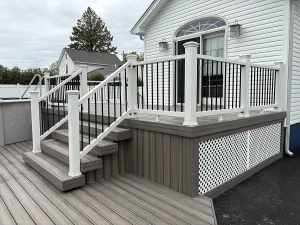
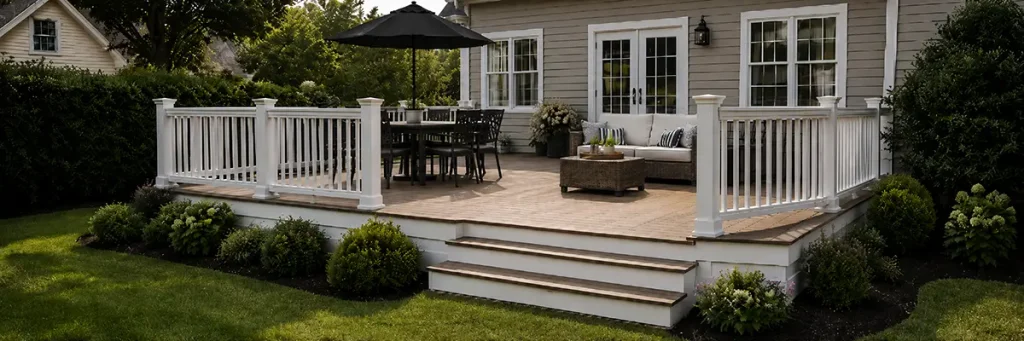
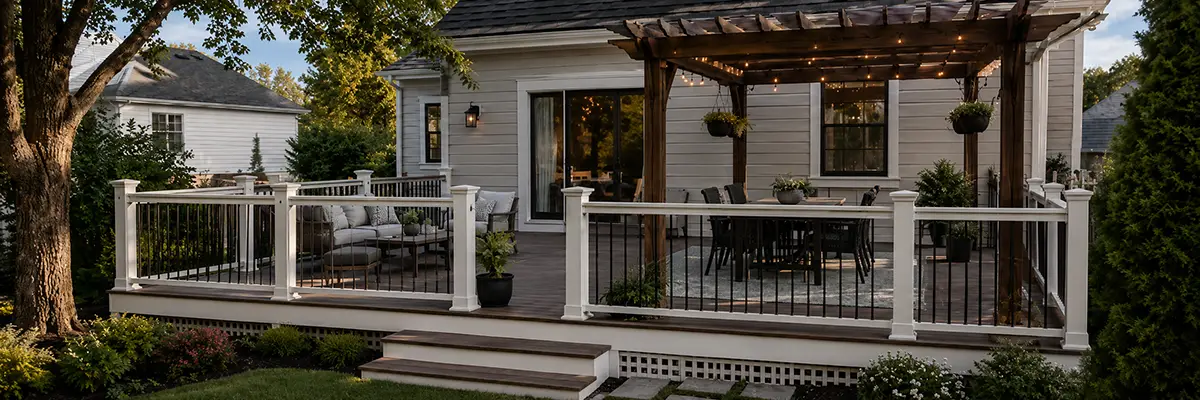
The housing stock at the center of Nassau leans classic — colonials and capes on village-sized lots. A sprawling deck that would suit a North Shore acre would swallow a Garden City or Franklin Square backyard whole. What works here is proportion: a deck scaled to the rear elevation of the house, with railing and trim details that echo the architecture instead of fighting it.
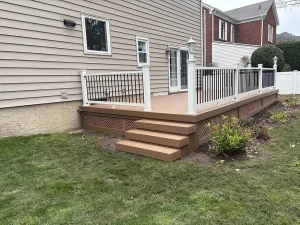
On a colonial, that usually means managing the drop from a raised first floor — wide stairs, a landing that breaks the descent, a picture-framed border that reads as finished millwork. On a cape, the floor sits lower, so we often design low-profile platforms that stretch the usable yard without towering over the fence line. On a smaller lot, every square foot has to earn its keep: built-in benches instead of bulky furniture, stairs where the kids actually cut through, the grill placed so smoke drifts away from your kitchen window — and your neighbor's.
Choosing Materials Before the Drawings Are Final
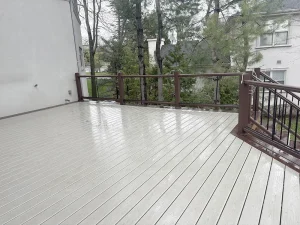
Material selection happens during design, not after, because it affects the plans we submit. Most of our central Nassau clients land on composite or PVC — Trex, TimberTech, or Azek — because they want weekends back. These boards keep their color through sun and freeze-thaw cycles, clean up with a rinse, and carry fade-and-stain warranties of 25 to 50 years; as Trex Platinum and TimberTech Pro certified installers, we add a 10-year labor warranty on eligible Trex lines. Compare the options on our composite deck builders page, or walk the full-size displays at our Commack showroom, 119 Commack Road, and feel the boards underfoot.
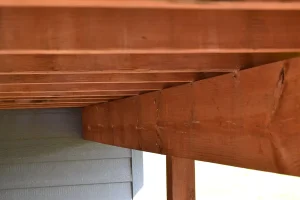
For homeowners who want real wood — and on a traditional colonial, mahogany has a hard-to-fake warmth — we build with natural lumber too, and we are honest about the staining and sealing schedule it asks for. Whatever goes on top, the frame underneath is kiln-dried-after-treatment (KDAT) lumber, which stays straighter than standard pressure-treated framing and carries a limited lifetime transferable warranty.
Stage Two: Village Permits, Done Right the First Time
This is where central Nassau differs most from the rest of Long Island. The first question is simply: who reviews your project? If you live in an incorporated village — Garden City, Mineola, Floral Park, Williston Park, East Williston, New Hyde Park, Westbury, Bellerose — your application goes to village hall, and each village has its own forms, fees, and review cadence. If you live in an unincorporated hamlet — Franklin Square, Elmont, Carle Place, Albertson, Herricks, Garden City Park, New Cassel — you go through the Town of Hempstead or Town of North Hempstead building department instead. Many homeowners learn which category they are in from a permit clerk. We know before we draw.
What a Thorough Review Actually Looks For
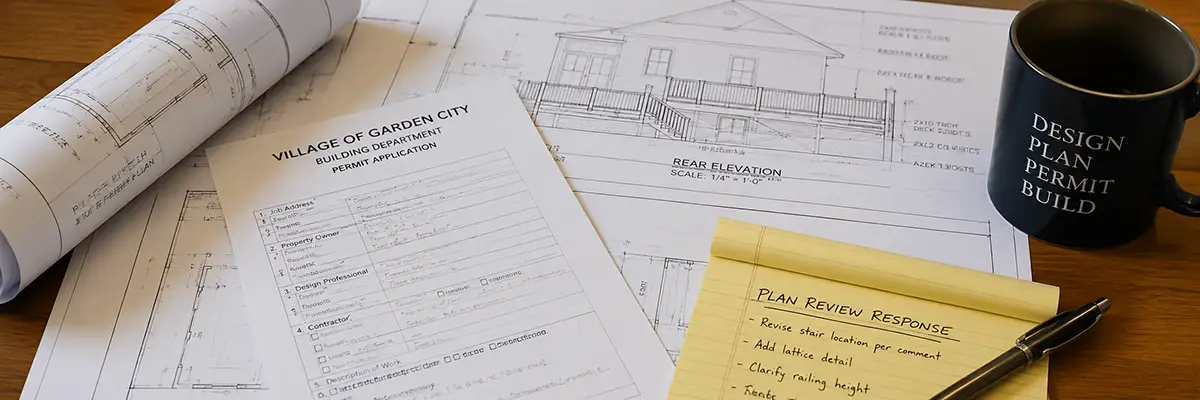
Garden City's reputation for careful review is deserved — it is why the village looks the way it does. A complete submission there, as in the other villages, means a current property survey, a dimensioned plan view, elevations showing overall height and stair geometry, a framing schedule, footing sizes and depths below frost line, ledger attachment details, and railing specifications. Setbacks get checked against the survey line by line. An incomplete packet gets a comment letter, and your file goes to the back of the queue.
Our approach is to design to pass on the first pass: we prepare the full drawing set, file the application, answer reviewer comments with clean, referenced revisions, and schedule the footing, framing, and final inspections at the right stages. If your design needs a variance — a real possibility on smaller village lots where setbacks bite — we flag it during design, while the layout can still be adjusted.
Stage Three: A Build That Passes Inspection Without Drama
By the time we set the first footing, the hard conversations have already happened on paper. The build is where four decades of habits show. Concrete footings go below frost depth in undisturbed soil. The ledger is flashed so water sheds away from your home's rim joist instead of into it. Joist tape protects the top of every framing member before decking goes down. Hurricane-rated connectors tie frame to posts and posts to footings; stainless or ceramic-coated fasteners shrug off Nassau's damp springs and salted winters — all over KDAT framing that stays straight.
None of this shows in the finished photos, but it is exactly what the framing inspector looks for — and why we back every project with a lifetime workmanship guarantee. When the final inspection is signed off, you have a documented, code-compliant structure, which matters here for safety and for resale.
Pergolas for Village Backyards
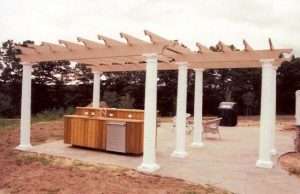
On a compact lot, shade has to be designed, not sprawled. A pergola over the dining end of a deck gives a Garden City or Williston Park yard a defined outdoor room without giving up open sky over the rest of the deck. We build everything from classic fixed-slat pergolas to automated louvered systems whose roof panels rotate at the touch of a button — open for sun, angled for shade, closed tight against a summer storm. In the incorporated villages a pergola typically needs the same permit review as the deck, so we fold it into the original drawing set. See the range on our pergolas and outdoor structures page.
Deck Resurfacing: The Faster Path Through Permits
Central Nassau is full of decks built decades ago whose framing is still solid but whose surface boards are splintered, faded, or endlessly hungry for stain. If an inspection confirms the frame is sound, resurfacing — new composite or PVC boards and railings installed on the existing structure — delivers a new-deck feel at a fraction of new-deck cost, and we reinforce any framing that needs it along the way. Permitting is often simpler when nothing structural changes, but rules vary, so we confirm with the building department before work begins.
Communities We Serve Across Central Nassau
From our Commack showroom we design and build throughout the middle of Nassau County. In Garden City, the county's signature village, we pair stately colonials with decks detailed carefully enough to satisfy its exacting review. In Mineola, the county seat, we work with the village building department on everything from cape-sized platforms to two-level builds. Franklin Square homeowners go through the Town of Hempstead rather than a village hall, and its postwar capes reward low, space-efficient designs. In Elmont, at Hempstead's western edge, we handle town permitting and build decks scaled to closely set lots. And in Floral Park, a village pressed against the Queens border, tight setbacks make our design-for-the-survey approach especially valuable.
We are equally at home between and around them: Carle Place, with its compact yards midway between Mineola and Westbury; the village of Westbury and neighboring New Cassel; New Hyde Park's tidy village lots; and Bellerose on the Queens line.
Several neighborhoods that once had their own pages on our site — Garden City Park, Garden City South, East Williston, Albertson, Herricks, and Bellerose Terrace — are now served right here — same designers, same KDAT-framed builds, same permit handling.
Frequently Asked Questions
What decking do you recommend for a home in Garden City?
For most Garden City colonials we recommend a premium composite or PVC board — Trex Transcend or Signature, or TimberTech's upper lines — in a tone that complements the home's trim, finished with a picture-framed border. These boards keep their looks without staining and carry 25-to-50-year fade-and-stain warranties. If you love real wood, mahogany suits the village's traditional architecture beautifully; we will walk you through the maintenance it requires.
Do you build pergolas in Garden City, Albertson, and Williston Park?
Yes — from fixed pergolas to fully automated louvered systems. In incorporated villages like Garden City and Williston Park, a pergola usually requires the same permit review as a deck, so we include it in the original drawing set. In Albertson, the application goes through the Town of North Hempstead instead. Either way, we handle the paperwork.
How long do village permits take for a deck?
It varies by village and by season — spring submissions face the longest queues, and Garden City's review is more thorough than most. The variable you control is completeness: a packet with a current survey, full framing schedule, and clear details moves through review far faster than one that draws comment letters. We prepare submissions to pass on the first review, respond to comments quickly, and start design early enough that the review clock runs while you are choosing board colors, not after.
Do you handle deck construction in Elmont?
We do. Elmont is an unincorporated hamlet, so permits run through the Town of Hempstead building department rather than a village hall — a process we navigate regularly. The construction itself gets the same KDAT framing and lifetime workmanship guarantee as every deck we build.
Can you repair my existing deck?
Our schedule is built around new construction and resurfacing, so we take on repair projects late in the season as time allows. If your framing is sound, resurfacing is often the better answer — an entirely new surface and railings on a structure we have inspected, instead of new boards next to old problems.
Start With the Design — We Will Handle the Rest
If you are weighing a deck, pergola, or resurfacing project anywhere in central Nassau, begin where every good project begins: a design conversation. Visit our showroom at 119 Commack Road in Commack to compare boards side by side, call us at (631) 623-9300 or (516) 689-7800, or request a free consultation online. We will design to your house, file with your village or town, and build something the inspector signs off on and your family wears in for decades.