


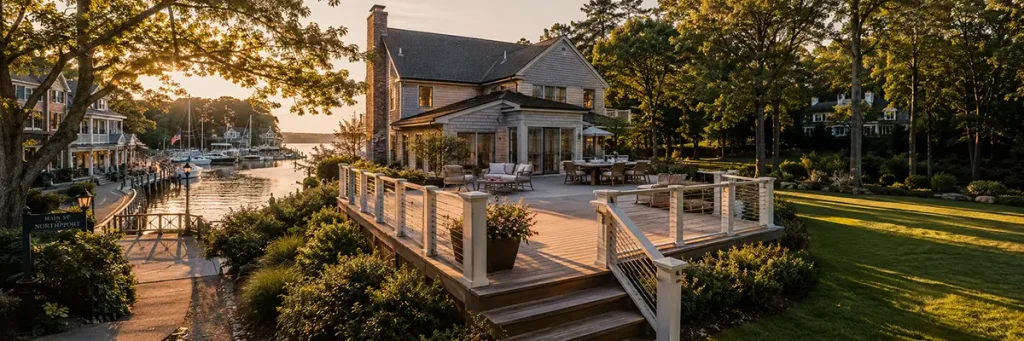
Stand at the bottom of Main Street in Northport and you can smell the harbor. Drive fifteen minutes south into Dix Hills and you're under a canopy of mature oaks on a lot that has never felt salt spray. That's Greater Huntington: one township, more than a dozen communities, and three different sets of questions to answer before anyone digs a footing. Long Island Deck Company - a Decks Unique company - has spent 39 years building decks across this stretch of the North Shore from our showroom in neighboring Commack.
Where your home sits in the township changes the materials we recommend, the hardware we spec, and sometimes the building department we file with - so this page is organized the way the area actually lays out: the harbor villages along Route 25A, the estate necks reaching into Long Island Sound, and the wooded hamlets inland toward the Northern State Parkway.
Three Bands, Three Different Decks
Think of the township in bands running north to south. The first hugs the water, from Huntington village out to Fort Salonga, where salt air, wind exposure, and sloping lots drive every design decision. The second is the estate necks - Cold Spring Harbor and Lloyd Harbor - where larger wooded parcels and bluff sites call for decks built at the scale of the architecture. The third is inland, from Huntington Station through Dix Hills and Melville, where the challenges are shade, mature trees, and pools rather than salt. A deck that's perfect in one band can be the wrong build entirely in another.
Around the Harbors: Huntington Village to Fort Salonga
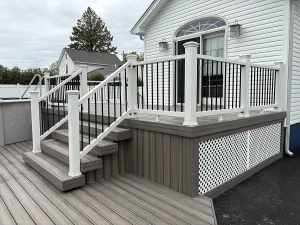
In and around Huntington village proper, lots tend to be tighter and many homes sit on grades that fall away from the house. We design multi-level decks that step down those slopes gracefully, keep stair runs where people actually walk, and use railing systems - cable or slim composite - that don't wall off what view you have.
Halesite, the hamlet wrapped around the head of Huntington Harbor, is as close to the water as you can live without a dock under your feet. Decks here see damp, salty air nearly year-round, so we steer Halesite homeowners toward capped composite or PVC surfaces, marine-grade hardware, and framing details that shed water instead of trapping it.
Huntington Bay occupies the high ground between the harbor and the open Sound, and many of its homes trade tight village lots for elevation and wind. Decks and pergolas in Huntington Bay are engineered for uplift first - hurricane-rated connectors, properly anchored posts, and shade structures that can take a stiff northerly without complaint.
Follow 25A east and you reach Centerport, draped around its own quiet harbor, and then Northport, the classic harborfront village. Both have a deep stock of older homes, so decks here often replace structures built to long-retired codes. We rebuild to current standards - ledger flashing, footing depth, code-compliant railings - with details that suit a century-old house rather than fighting it.
Asharoken is essentially a causeway with houses on it - a narrow strip between Northport Bay and the Sound. There is no such thing as a sheltered deck in Asharoken, so we treat every build there as a full marine-exposure project: PVC or premium capped composite decking, stainless fasteners throughout, and structural connections sized for wind off open water.
Past Asharoken, Eatons Neck sits at the end of the peninsula with the Sound on three sides. Projects here reward planning - access is by one road and the exposure is relentless - and we build Eatons Neck decks to outlast it.
At the township's northeast corner, Fort Salonga spreads along the bluffs and hills between Northport and the Smithtown line. Properties here mix Sound exposure with real woods, and many sit on sloped ground where footing depth and grading determine whether a deck stays level for thirty years or starts moving in five.
The Estate Necks: Cold Spring Harbor & Lloyd Harbor
On the township's western edge, Cold Spring Harbor faces its namesake harbor at the Nassau border, and Lloyd Harbor occupies the wooded neck beyond it. These are estate communities - long driveways, significant architecture, parcels measured in acres - and the decks need to hold their own.
We design at the scale of the house: broad, picture-framed composite or mahogany-look surfaces, multiple defined zones for dining and lounging, integrated lighting, and pergolas proportioned to the rooflines behind them. On bluff and shoreline sites we engineer conservatively - deeper footings, a continuous load path from decking to ground, and hardware rated for coastal wind. Lloyd Harbor is an incorporated village with its own building department; we manage that review start to finish.
The Inland Hamlets: Greenlawn to Melville
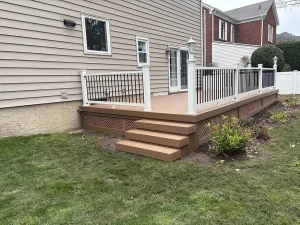
South of the harbors, the township turns leafy and residential. Huntington Station and Greenlawn carry generations of capes, colonials, and split-levels, where the most common project is replacing a tired wood deck with a low-maintenance composite one. East Northport, between them and the Sound communities, fits the same profile.
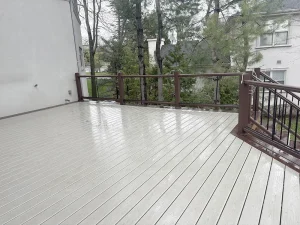
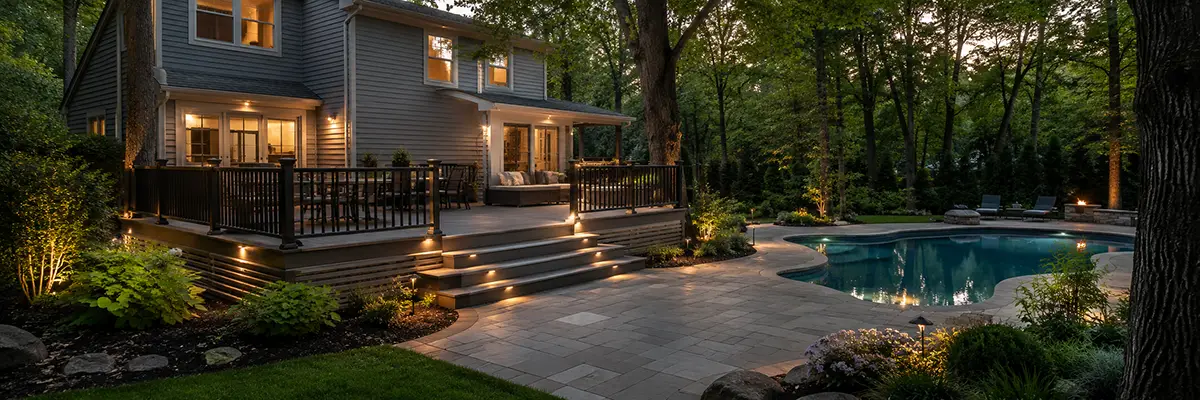
Elwood sits just over the line from our Commack showroom - some of the shortest drives on our schedule. And in Dix Hills and Melville - along with the wooded hills of West Hills - the defining feature is the trees. Big, established lots under heavy canopy stay damp and shaded, which favors PVC decking that resists mildew, ventilated framing details, and lighting that makes the deck usable after the early dusk a tall tree line creates. Pools are common here, and we regularly tie pool, patio, and back door into one connected plan.
Decking Materials That Earn Their Keep Here
Across all three bands, most Greater Huntington homeowners land on Trex or TimberTech composite for the surface - realistic grain, hidden fasteners, and fade-and-stain warranties running 25 to 50 years depending on the line. Near the water we frequently recommend PVC, which contains no wood fiber and shrugs off the moisture that harbor-adjacent decks live with. For homeowners who want real lumber, we build with pressure-treated pine, cedar, and mahogany, and we're upfront about the staining-and-sealing schedule each demands in North Shore conditions.
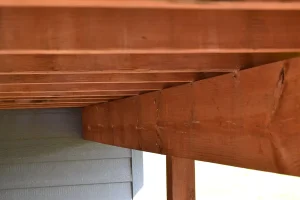
Underneath, every deck we build is framed with KDAT lumber - pressure-treated wood that's kiln-dried after treatment so it starts straight and stays straight. On the raised and walk-out decks common on Huntington's sloped lots, where the frame is visible from below, that stability shows. The KDAT framing carries a limited lifetime transferable warranty, our workmanship is guaranteed for life, and as a Trex Platinum installer we can offer a 10-year labor warranty on eligible Trex Signature and Transcend projects.
Pergolas for Huntington Yards - Fixed, Retractable & Louvered
A pergola changes how many hours a day a deck gets used - doubly true on the North Shore, where a waterside deck can be blazing at two and breezy by six.
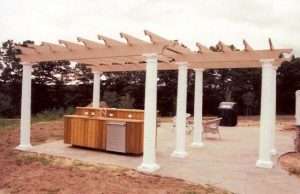
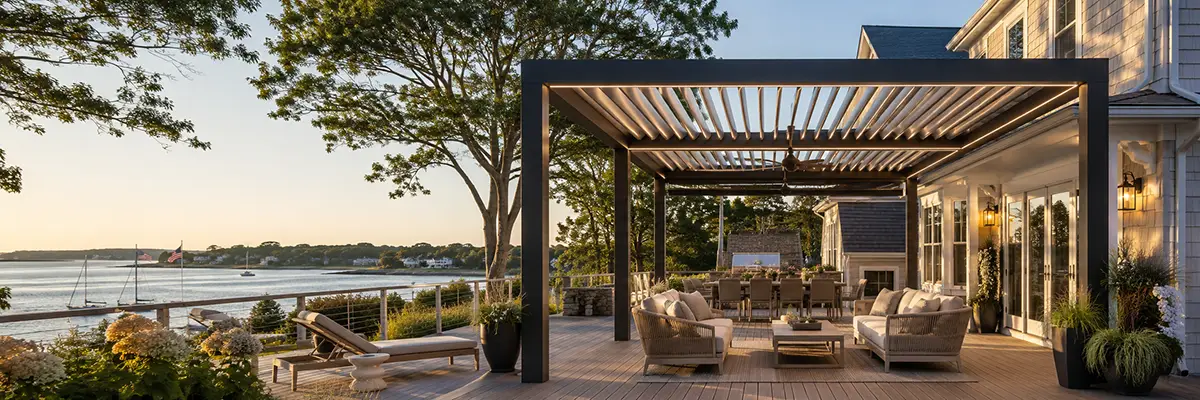
We design and build pergolas and outdoor structures ranging from classic cedar designs to motorized aluminum systems with louvers that open for sun, close against rain, and integrate lighting and fans. On exposed harbor and bluff sites we anchor and engineer pergolas for wind the same way we do the decks beneath them; on shaded inland lots in Dix Hills or Melville, a pergola is often less about shade and more about defining an outdoor room under the trees.
Deck Resurfacing Across Greater Huntington
Plenty of decks in this township were framed well decades ago and simply wear a surface that's past its prime. If an inspection shows your structure is sound, resurfacing - new composite or PVC decking, new railings, new lighting, over the existing frame - delivers what looks and feels like a new deck at a meaningful savings over full replacement. It's an especially good fit in established neighborhoods where solid 20- and 30-year-old frames are common. We check the framing honestly first; if it can't be saved, we'll tell you.
Permits: One Town, Several Village Building Departments
Permitting in Greater Huntington has a wrinkle most areas don't: alongside the Town of Huntington's building department, several incorporated villages - Northport, Lloyd Harbor, Huntington Bay, and Asharoken among them - run their own review processes. We prepare the plans, file with the right office, schedule the inspections, and see the project through to sign-off no matter which jurisdiction your address falls under. You enjoy the deck; we chase the paperwork.
Minutes from Our Commack Showroom
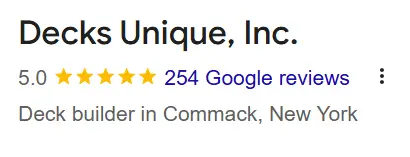
Our showroom at 119 Commack Road in Commack borders the township - a short hop from Elwood, East Northport, and Dix Hills, and an easy drive down Jericho Turnpike or 25A from the harbor villages. Walk full-size deck displays, put your hand on Trex and TimberTech boards in real light, test railing systems, and see deck lighting as it will look at night. We're licensed and insured, Trex Platinum and TimberTech Pro certified, and carry a 5.0 rating on Google.
Greater Huntington Deck Questions, Answered
How do I choose a deck builder in Huntington?
Look for real familiarity with Town of Huntington and village permitting, manufacturer certifications that unlock genuine labor warranties, and a physical place to see the work before you sign. We've built here for 39 years, hold Trex Platinum and TimberTech Pro status, back every project with a lifetime workmanship guarantee, and keep full-size displays at our Commack showroom.
Do you cover the north Huntington waterside neighborhoods?
Yes - Halesite, Huntington Bay, Asharoken, and Eatons Neck are all regular territory for us. Decks that close to the harbor and the Sound get marine-grade hardware and salt-tolerant decking as a matter of course, and where an incorporated village has its own building department, we handle that filing directly.
Can you build a pergola in Huntington Bay?
Absolutely - afternoon sun off the water makes shade valuable. The key in Huntington Bay is engineering: a pergola on an exposed site needs posts anchored for wind uplift and coastal-rated hardware, not just good looks. We build everything from fixed cedar pergolas to motorized louvered systems that close themselves when rain starts.
Do you handle deck repair in Fort Salonga?
Honestly: we take on repair projects late in the season, after the year's new builds and resurfacing work wind down. If your Fort Salonga deck needs attention, reach out and we'll schedule you realistically. If the damage is widespread, it's worth an inspection first - sometimes resurfacing over a sound frame is a smarter spend than patching a failing one.
Can I remodel my existing deck in Huntington instead of replacing it?
Often, yes. If the framing checks out, we can resurface - new decking, railings, stairs, and lighting on the existing structure - or reconfigure the layout while reusing sound framing. We inspect first, reinforce where code requires, and only recommend full replacement when the structure genuinely calls for it.
Ready to talk about your project? Contact us for a free design consultation and quote, or call (631) 623-9300 or (516) 689-7800.